Imagine a universe
filled with light. Imagine worlds fashioned from pure light, where every feature
of the landscape is formed out of flowing streams of light, where hills and
valleys, mountains and plains are sculpted from an abundance of glorious radiant
light. Imagine oceans of light, lakes of light, all interconnected by rivers of
light, adding yet further to these wonderful worlds of pure luminescence.
As if that's not
enough, imagine planets decorated with trees woven from strands of light, plants
intricately formed from threads of different coloured light that combine to form
countless marvellous shapes and forms. Imagine dragonflies, bees, myriad other
insects, each one of them created from filaments of light spun together like
some fantastic creation of gold wire filigree - except that they live and move.
Imagine now a
limitless variety of creatures that roam these amazing planets, creatures that
crawl or slither, creatures with two legs or four, or more, or with wings that
carry them seemingly effortlessly above the surface of their world. Imagine
every one of these creatures being fashioned from pure light, nothing more,
nothing less.
Let your imagination
soar now, as you visualise highly evolved light-beings with intellect and
self-awareness, godlike creatures that have the power to shape and control every
aspect of their luminescent landscape through their thoughts and decisions.
Imagine what life might be like for such a being, formed from pure light, living
in an environment also formed, in every part, from pure light.
- - - - - - - - -
[top]
Walking the Light-Fields
In the beginning ...
the earth was without form and void ... And God said "Let there be light".
And there was light.
Genesis I, verses 1-3.
Every scientific text
that describes the very beginning of the universe, the Big Bang that kicked it
all off, tells us that the very first thing that happened in the first billionth
of a billionth of a billionth of a billionth of a second or so was a vast
outpouring of photons - light. We're also told that even now the average density
of photons of light throughout the universe outnumbers the density of particles
of matter by many billions to one.
In that very first
instant of its life the entire universe was, so we're told, packed into a space
smaller than a single subatomic particle . In that intensely tightly compacted
fireball of energy, every possible configuration of energy-pattern would have
been played out, and those that proved to be stable would have held their form
as that fireball expanded and cooled, whilst unstable configurations would have
simply come apart.
So it came about that
a tiny fraction of that explosion of light, described almost identically in
religious and scientific texts, wrapped itself around into tight balls that
we've chosen to call particles. It's that tiny fraction, those freak accidents
(or intentional patterns, take your pick) of the tangled energies in the
original cosmic fireball that now form all the material objects in the whole of
our universe.
Accident or
intention, those curled-up photons went on to combine to form protons and
neutrons, as well as electrons, then atomic nuclei that later combined with
those electrons to form complete atoms. Over billions of years stars formed,
generating a wealth of different atomic structures from the first hydrogen and
helium atoms by the process of nuclear fusion.
That same fusion
process provided light and heat to encourage the formation of complex molecules,
then self-replicating combinations of those molecules - otherwise known as
'living organisms' - and the rest is history.
- - - - - - - - -
[top]
Occam's Razor
A guiding principle
for researchers over many centuries, Occam's Razor was originally translated as
'Do not multiply entities unnecessarily'. We might say 'Don't introduce
unnecessary complications' or 'Don't clutter the field with more players than
you need'. In science this provides us with the very sound maxim: 'Don't assume
any more basic concepts than you absolutely have to'.
Breakthroughs in
science have almost always been heralded by the need to shore up a previous
world-view with increasingly complicated laws or 'special cases' that eventually
make that view so top-heavy as to be untenable. Two good examples are the
epicycles of the Greeks and the phlogiston of the early chemists.
When people believed
that the earth was fixed in the heavens, with the rest of the universe rotating
around it, the 'orbit' of the sun was easy as it made a nice neat circle (near
enough) around our planet. After that it got tricky, with the other planets
moving in epicycles around the earth - think of a fly on the rim
of a small wheel that's being rolled along the outer rim of a large wheel: the
fly is tracing out a series of epicycles.
The situation got
even more difficult with other stars, that seemed to move in epicycles traced
around epicycles centred on the earth. Being very good mathematicians the Greeks
had no trouble working out the maths but in practical terms it made the universe
seem to be an increasingly complicated system.
All of this
mathematical baggage was swept away at a stroke when it was recognised that in
fact the earth rotates around the sun and isn't actually the centre of the
universe.
- - - - - - - - -
[top]
KISS and Tell
Ok, let's try and
build a picture of material reality based on as few assumptions or different
types of building blocks as possible. What's the very least we can start
with to construct a working model of the universe?
No point in starting
with atoms - too many different types. Going down a level into the realms of
protons, neutrons and electrons doesn't help, either. Here we come up against a
whole mess of other elementary particles - various baryons, mesons and leptons
that add to the confusion by hanging around for mere billionths of a second or
less before shape-shifting into others of their clan - kaons to pions, pions to
muons ...
As often as not this
can also involve the 'decay' of those sub-sub-atomic particles, quarks, with all
their weirdly-named qualities: topness, bottomness, colour (that isn't actually
colour), strangeness (that is actually rather strange), charm (that's neither
magical nor charming). What can be relied upon as a starting point for
our exploration into the nature of material reality?
The answer is, of
course, staring us in the face. The one constant feature of this quantum
landscape is its ever-changing layout, the flow of one form into another.
Embrace the change, use it, work with it. Go with the flow.
- - - - - - - - -
[top]
More Speed, Less Haste
(Or: If you want time
to go slower, move faster)
- - - - -
Now think of a light
aircraft leaving a trail of orange smoke - skywriting. Just to Keep It Simple,
we'll assume that the plane flies 5 kilometres (km) every minute. Let's say the
pilot has a thing about tracing out vertical circles in the sky, each exactly 1
km around.
If he does this in
the same place all the time, 'following his own smoke' and tracing out the same
circle over and over, he'd perform exactly five circles each minute. But if he
decides to travel cross-country while he's drawing his circles (still keeping
the diameter the same) he may only trace out four, or even three each minute,
because some of his orange smoke is used up in moving horizontally, in the
diagonals of his spiral flight pattern. If he sees his fuel's getting low and he
needs to get back to base, he may stretch his circles right out, perhaps forming
just a couple of long spiral loops in the 50 km flight home.
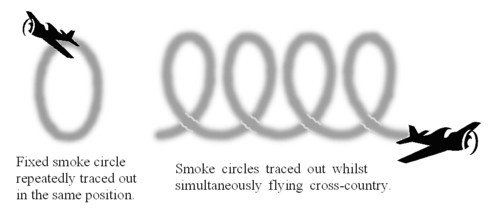
Now let's scale down
quite a bit (!!), to the cyclic energy-flows in our sub-atomic particle. Same
principle as our pilot's orange smoke. If the particle stays in the same place
then the energy flow traces out the same number of circuits every second. Kick
the particle off at speed in any direction and some of the energy flow is used
up in just travelling along, leaving less to loop-the-loop each second in its
formation of the 'particle'
Notice the difference
here: the orange smoke marks out the track of the plane, the energy flow
is the particle. Everything that happens in that particle happens because
of that flow. Any interaction between two or more particles is interaction
between their flows. So if, for example, the flow in a particular particle loops
round at 1,000 time a second then the effects of any interaction will be carried
round that particle quicker than if the rate is reduced to 900 loops a second.
If we think of a
system, or collection of particles that make up, say, a machine, or a living
organism, or even a rock, the particles in that system interact with each other
and with others around them - such as the air, moisture, or whatever the
rock/gadget/small furry creature may be resting on.
It's those
interactions that give rise to what we refer to as 'the passage of time', or
'ageing', as experienced by the rock/gadget/small furry creature. That ageing,
that passage of time, depends on the rate at which the cyclic energy flows carry
the effects of those interactions around the various particles that make up the
object, whatever form it takes.
- - - - - - - - -
[top]
Dancing the Light Fantastic
Every object in the
universe, living or inanimate, experiences the effects of everything else around
it in terms of how they affect it. They may hit it, heat it, eat it -
whatever. That's not an ego thing, it's just how the universe operates. If I'm
driving along at fifty miles an hour, round a bend, and right there in front of
me is a tree across the road, it's no great consolation that the tree is
travelling at speed zero. The significant thing to me is the speed at which the
tree is closing on me and how that event impacts on the various elements -
ultimately the uncountable energy flows that make up those elements - in my
body.
- - - - -
Have you ever been
sitting in a train that's standing in a station, then suddenly had that strange
impression that the platform next to you has started moving and is heading away
from you down the track, back the way your train came in? If there wasn't an
obvious sensation as your train pulled away, it can take a second or two to
register that it's you that's actually moving and the platform is still firmly
fixed where it was.
Every object - every
particle of every object - will respond to its surroundings as if it is
stationary and it's the things around it that are moving. It can't do anything
else, since it is effectively the centre of its own personal universe. So a
moving object will respond to everything around it as if it were standing still,
as if its particle energy-flows weren't partly occupied in carrying it through
space but were wholly involved in circulating round those particles, notching up
time-experience.
This gives our object
a whole new slant on reality - literally. Its energy-flows are 'diagonal' -
across space and around each particle - but it responds to external influences
as if those diagonals are 'vertical', its particles not moving through space at
all
It's just like a
person who's leaning forward, but thinks that they're standing upright. They
will see other people - who are standing upright - as leaning backwards,
and they'll see the ground as tilted when it is in fact level. In this context
'upright' is the direction of time-experience and 'level' is the direction of
spatial movement (see the energy-flow triangle at the start of this chapter). So
a moving object will have a distorted perspective on both time and space,
experiencing both 'at an angle', so to speak. In particular it will experience
the effects of other objects or influences rather differently from if it were
stationary.
- - - - - - - - -
[top]
Try To See It My Way (We Can Work It Out)
(With thanks & apologies to the
Beatles)
When it was shown
beyond doubt that the speed of light measures the same from all states of
motion, various people tried to explain this rather bizarre result. One
contemporary of Einstein, Hendrik Lorentz, suggested that it might be due to
changes in the length of objects travelling at speed, but he wasn't able to find
a formula that worked for this idea. Perhaps if he'd had the benefit of a
well-developed and accepted Quantum Theory ... - but that was some time in the
future.
One major
contribution that Lorentz did make to Relativity Theory was the Lorentz
Transformation. This is actually a set of equations that allows one object's
reality to be re-cast into the form that it's experienced by another object in
motion with respect to the first. The Lorentz Transformation is essential for
any scientific work involving relativistic speeds (near-light-speed).
- - - - -
If we apply the
concept of cyclic energy flow to the issue, with no assumptions of any of the
results from Special Relativity, we arrive at exactly the same formulae as
Lorentz did. The following summary gives a non-technical overview of how those
formulae are reached.
- - - - - - - - -
[top]
Inertia - A Moving Experience
- - - - -
The triangle below
shows the energy flows when the object is moving at 98% of the speed of light -
the horizontal side (linear flow) is 98% of the length of the diagonal side
(total flow). Here the total energy needed by the object works out to about five
times the energy that provides the structure of the object at rest - the longest
side (total flow) is about five times the length of the vertical side (cyclic
flow).
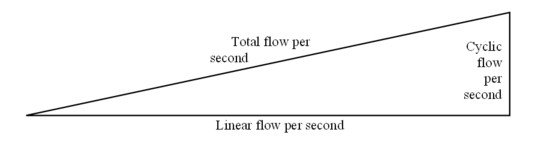
As we get very close
to the speed of light the situation gets pretty tricky. There's no way the
diagrams would fit on any page in this book! At 99.99% of the speed of light the
base of the triangle would have to be 99.99% of the length of the diagonal side.
This means that our
triangle would have to have a diagonal side over seventy times the length of the
vertical side. In other words the total energy flow in our object travelling at
99.99% of the speed of light would have to be over seventy times the energy in
that same object at rest.
At 99.999999% of the
speed of light, the diagonal of our triangle would be over seven thousand times
the length of the vertical side. Our object would need over seven thousand times
its rest-energy to travel at that speed.
- - - - - - - - -
[top]
[Tapestry of Light details]